
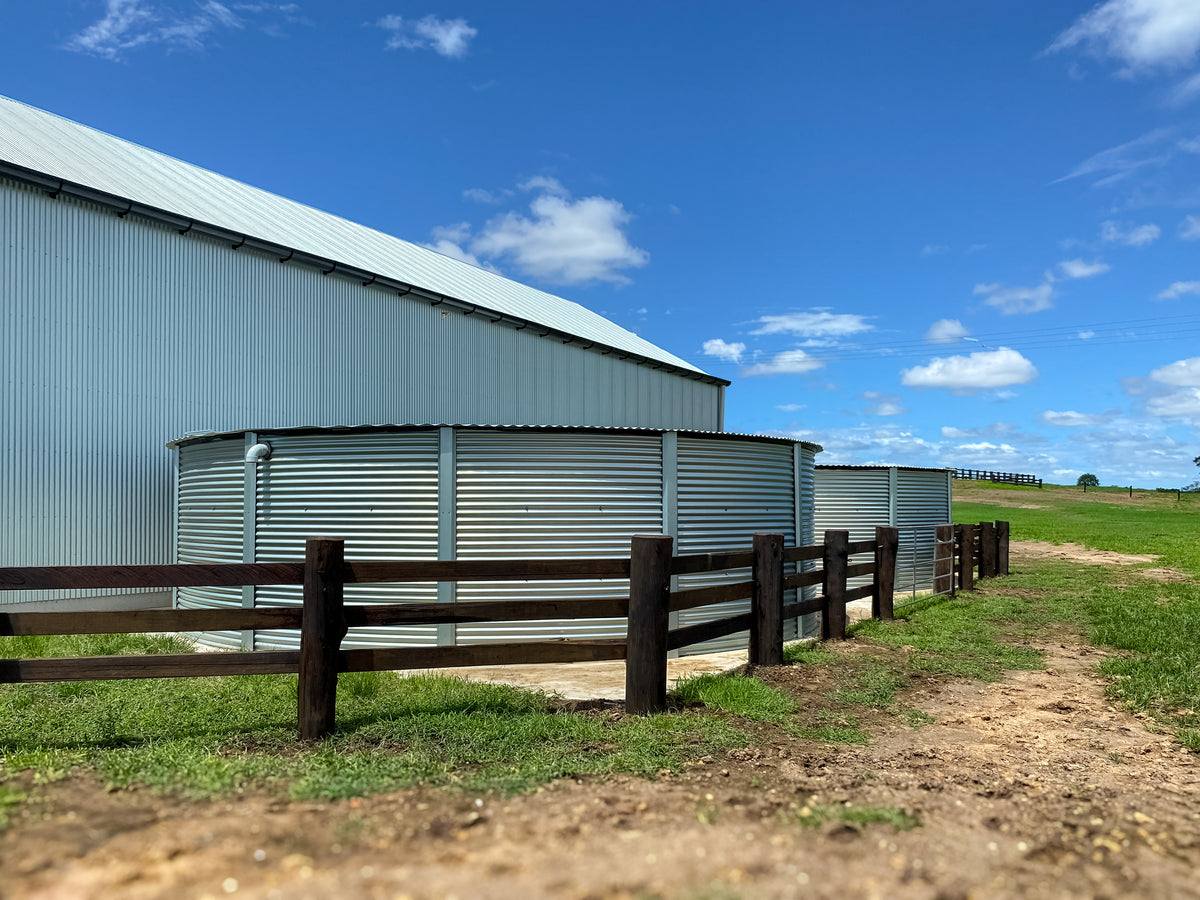
Steel Liner Tanks

CCWT Steel Liner Tanks are large capacity water tanks built on your site or property from prefabricated steel walls and a durable internal liner. Available in capacities from 33,000 to over 132,000 litres, these water tanks provide are the ideal solution for bulk rainwater harvesting, whole-home supply, stock water, irrigation, and other large-scale agricultural or commercial water storage needs.

Unlike our Aquaplate Steel® water tanks, which are pre-manufactured in our factory and delivered as complete units, Steel Liner Tanks are transported to your property in individual components and built by our professional team on-site. This allows huge volumes of water storage possible without the access or transport restrictions that come from delivering a fully assembled tank. All our designs and systems have been professionally engineered and certified, providing reliable bulk water storage for commercial and rural properties in our demanding Australian conditions.

  • A Range of Sizes

    Different capacities and sizes to suit your needs

  • Cost-effective

    The most economical way of storing large volumes of water

  • Efficient Build Process

    Standard installations completed within 2 days

  • Local Support

    Manufactured and assembled by locals

Frequently Asked Questions

About Steel Liner Water Tanks

What is a Steel Liner Water Tank?

A Steel Liner Water Tank combines a strong, corrugated steel support structure with a flexible interior liner that actually holds the water.

What are the advantages of a Steel Liner Tank?

Steel Liner Tanks allow very large volumes of water to be stored in a single tank, while still being practical to transport to your site.

Because the tank arrives in individual sheets and components, site access can be significantly easier than larger prefabricated tanks.

Frequently asked What is the difference between a Steel Liner Tank and an Aquaplate Steel Tank?

Our Aquaplate Steel tanks are manufactured in our factory and delivered as one complete unit ready for installation.

Steel liner tanks are transported in pieces and built on-site before hanging an internal liner to store water in.

Are CCWT's Steel Liner Tanks engineered?

Yes. Our Steel Liner Tanks are available in set sizes to meet robust engineering requirements and ensure absolute longevity and reliability.

Our engineer certified range goes from 33,000 to 132,000 litres.

Tank Sizes & Capacities

Do you make 100,000 litre water tanks?

Yes. Our Outback Range of Steel Liner Tanks are over 111,000 and 132,000 litres of capacity, making them more than suitable for applications where 100,000 litres (or 100 kL) of water storage is required.

What is the largest Steel Liner Tank?

Our largest model, the Outback 13-2, holds 132,196 litres of water and is 8.95 metres in diameter.

What size water tank do I need for my property?

That depends on the use of your water, your available catchment area, local rainfall levels, the number of people, animals, or crops relying on the water supply, and whether the tank also requires a dedicated firefighting reserve.

If you are unsure, give our friendly team a ring to chat about your property and intended use.

Liners & Water Quality

What liner is used inside CCWT Steel Liner Tanks?

CCWT Steel Liner Tanks use Jaylon ARMALiner, a reinforced PVC coated woven polyester liner.

It is a UV stabilised 680 GSM meeting the strict Australian potable water requirements of AS/NZS4020.

Can a Steel Liner Tank store mains or chlorinated water?

Yes. ARMALiner supports up to 2 parts per million (ppm) of chlorination in continuously stored water.

Standard mains water is around 0.2-0.5 ppm.

Can I store bore water, stock water, or irrigation water?

Many bore water supplies would be suitable, but the chemistry of your bore water varies between properties.

Clean water for stock watering or irrigation is also suitable for our Steel Liner Tanks.

Where heavy mineralisation, chemicals, or other additives may be added to the tank, contact us for additional information to ensure you retain your robust 30-year warranty.

Tank Construction & Installation

What are CCWT Steel Liner Tanks made from?

The tank will use corrugated Zincalume or Colorbond® steel water panels around the water liner, with an engineered steel roof and supporting structure.

What comes as standard with a Steel Liner Tank?

The standard inclusions are a 500mm inlet strainer, 100mm overflow, 50mm outlet and ball valve, 25mm outlet and ball valve, lockable access hatch with a ladder, vermin proofing, and sacrificial anodes.

Can I add extra fittings to the tank?

Yes. Additional outlets, inlets, and a wide range of other additional fittings can be added to suit your site and custom requirements.

Can I add a Storz fitting to use the tank for firefighting?

Yes. Storz fittings and other special connections can be added to make the tank suitable for strict BAL requirements, or to make the tank a dedicated static water storage system for bushfires.

Installation & Site Preparation

How long does a Steel Liner Tank take to install?

Most CCWT Steel Liner Tanks can be assembled in 1-2 days when the site and tank pad have been properly prepared.

Installation is weather dependent. high winds, rain, and unsafe site conditions can delay or stop work.

What type of base does the tank need?

They require a properly prepared, level, and compact pad.

Our preferred pad material is crusher dust with a maximum particle size of 5mm, but draining river sand may also be used where appropriate. Read our Liner Tank Pad Guidelines for more information.

What happens if my pad is not ready on the installation date?

If the site or pad doesn't meet requirements, the installation may need to be rescheduled.

This can result in additional travel and labour charges. Following the pad preparation guide is considerably cheaper than trying to correct a non-compliant pad on the installation day.

Do I need to fill the tank with water on installation day?

Yes. At least 100mm depth of water needs to be placed into the tank on the day of installation. This helps secure the liner and keep it correctly positioned.